
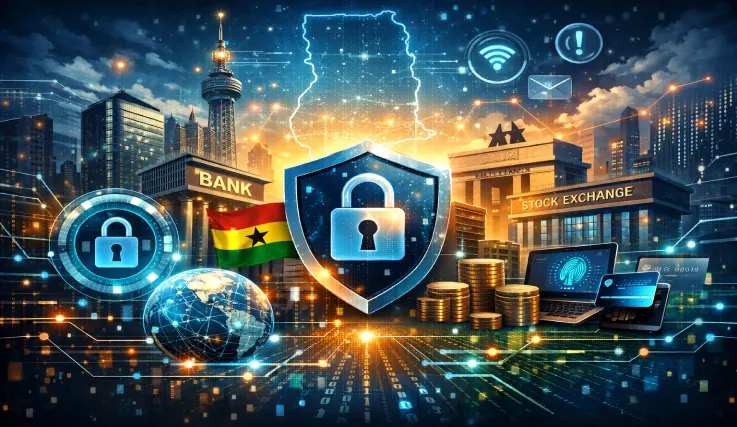
A Foundational Pillar for Growth: Cybersecurity for Ghana's Financial Sector
Cybersecurity has become a very important field for the financial sector in Ghana, and it is among the pillars of its growth. The financial sector in Ghana enjoys the status of being a facilitator of innovation and economic progress. It is a leapfrogging market with respect to technology, as it has encompassed a digital ecosystem that is expanding at a fast pace. This ecosystem includes the traditional banking system, dynamic and innovative fintech startups, and internationally appreciated mobile money platforms like MTN MoMo, T-Cash, and AirtelTigo Cash. Therefore, the financial sector is the leader in the provision of financial services to the majority of the population, and this is also one of the reasons for the increasing usage of such systems.
However, the highly interconnected and fast-paced nature of the digital transformation also means that businesses are exposed to and more susceptible to a variety of online threats. In the case of the financial sector in Ghana, the robust security issue is not merely a problem of insignificance but has become the biggest root of the operational integrity, trust of clients, and the possibility of growth. This is so, through;
Understanding the Cyber Threat Landscape in Ghana's Financial Sector
The cybercriminals targeting the finance sector have been very specific in their attacks on Ghana's digital financial space. Despite the presence of locally tailored assaults, the threat landscape is a diverse mix of attacks from around the world. Financial institutions face a range of evolving cyber threats that are often successful but not unusual. Phishing, the most common cyber threat, involves employees and customers falsely revealing personal or company information. Phishing campaigns often succeed, leading to serious security breaches for companies. Ransomware is another serious issue; it is a malicious virus that first hides in encrypted data storage and then locks the server, demanding a large ransom to resume normal operations, causing maximum disruption.
Moreover, fraudulent activities are a constant challenge confronting the sector, especially with respect to electronic and mobile money avenues for fraudsters. Among the various types of fraud, social engineering is the most typical one, and SIM swap and transaction attempts are not uncommon. One of the risks that makes the sector especially susceptible to fraud is the internal threat, whether it results from negligence or is caused by an intentional act, in which individuals with authorized access alter systems or data. This gives rise to the necessity of knowing the whole situation as the very first and vital action to be taken to be well defended, suggesting that cybercrime prevention procedures within the banking sector in Ghana need to be extremely alert and ready for both attacks from the outside and vulnerabilities from the inside.
Why Cybersecurity Is Critical for Financial Businesses in Ghana
It's not just technical compliance that matters; cybersecurity measures are indeed an absolute necessity. The type of security breach is wide-ranging and very awful. Direct losses, including fraud, theft, ransom payments, and penalties from regulators, can bring a financial institution down altogether. For instance, the Bank of Ghana's cybersecurity rules set forth precise expectations, and non-compliance could result in heavy fines.
In the long-term perspectives, the worst reputational damage might be the one that accompanies a security incident that has become public. Trust is the foundation upon which the financial sector is built. A single major data breach or a widespread service outage can easily erode customer confidence, hence leading to attrition and loss of income. There is no arguing that in a world where customers have more than enough choices, trust is the most valuable asset. Therefore, this directly correlates with the issue of continuity in business. Making the uninterrupted and safe availability of financial services is not only a matter of the institution's survival but also of the national economic system's stability.
Establishing a Cybersecurity Governance Framework
The foundation of a strong defense is the leadership aspect of it. The establishment of a Cybersecurity Governance Framework formalizes the cybersecurity posture. This development requires the precise delineation of organizational policies, standards, and procedures that govern the protection of data and systems. It requires the allocation of roles and responsibilities, starting from a dedicated Chief Information Security Officer (CISO) or the designated executive, to every employee who deals with data.
At the heart of this framework is a very active practice of risk assessment and management. Financial organizations have to constantly pinpoint their most important digital assets, evaluate the particular threats to these assets in the context of Ghana, and apply the necessary controls prioritized to reduce the risks. This methodical, top-down approach makes it possible for security to be seen as a core business risk and is therefore aligned with the institution's overall risk appetite as well as strategic objectives when making security-related investments.
Implementing Strong Access Controls and Authentication
A core security principle is guaranteeing that only authorized persons get access to certain systems and data. The implementation of strict access controls is the key. This begins with the global application of Multi-Factor Authentication (MFA) for all employee and customer-facing systems. MFA cuts the risk of account takeover considerably, even if passwords get into the wrong hands, as it demands a second form of verification.
On the other hand, through Role-Based Access Control (RBAC), the principle of least privilege has to be implemented internally. The staff should have access only to the information and the systems that are absolutely required for the performance of their job functions. This not only limits the potential harm caused by both compromised accounts and insider threats but also creates barriers that are so granular that they can even contain breaches within the network.
Encrypting Financial Data and Securing Backups
Financial data is the sector's lifeblood and needs to be protected in all conditions. Encryption is a must-have. Customer account details and transaction records are among the sensitive data that have to be encrypted during their whole life cycle: at rest (when stored on servers, databases, or backups) and in transit (when sending data across networks, such as during online banking sessions). This way, even if attackers manage to intercept or steal the information, it will still be useless to them. Protecting data in transit is particularly important for preventing man-in-the-middle attacks where cybercriminals attempt to intercept communications between parties.
A strong strategy for protecting and testing data backups regularly is just as important. In case of a ransomware attack or system failure, backing up data securely, offline, or using immutable backups is the last line of defense for regaining operations without giving in to extortion. An effective backup and disaster recovery plan is a key element of cybersecurity for any financial institution in Ghana.
Employee Training and Cybersecurity Awareness Programs
The secure environment is not solely the result of technology. The biggest risk factor in cybersecurity is human error. An attacker can gain access to the entire network just by one employee clicking on a harmful link. Thus, there is a necessity for ongoing employee training and cybersecurity awareness programs, which are good and essential investments.
Training has to be transformed from annual compliance seminars to making it engaging, regular, and relevant. Staff should get the knowledge of how to identify phishing attempts, keep their passwords strong, and follow secure procedures for handling customer data. Simulated phishing exercises are very effective in testing and reinforcing this knowledge. By converting the workforce from a possible weakness to a vigilant first line of defense, organizations enormously reinforce their security posture. Understanding and implementing best practices for business cybersecurity is essential for creating a security-conscious culture.
Monitoring Transactions and Detecting Fraud in Real Time
For financial services, security is not a one-time thing; it is a continuous process of alertness. Setting up systems for monitoring transactions and detecting fraud in real time is very important for protecting customer assets. Modern analytic tools can make behavioral baselines for account activity and immediately flag anomalies, such as super big transfers, login attempts from overseas places, or fast-moving transactions.
Through this constant monitoring, suspicious activities are detected early, thus security teams can intervene before any significant loss takes place. The systems are also critical for mobile money providers and banks with digital services in fighting the rapid fraud schemes that are common in the ecosystem.
Incident Response Planning for Ghanaian Financial Institutions
No matter how good the security measures are, the question is not if, but when a security incident will happen. The institution's response defines how prepared it is. Having a carefully prepared and periodically tested Incident Response (IR) Plan is indispensable. The plan indicates the specific order of command, communication protocols (including when and how to inform the regulators, like the Bank of Ghana and affected customers), and detailed ways to contain, eliminate, and recover from the incident.
Regular tabletop exercises and drills make certain that the IR team can respond quickly and efficiently even during stressful situations. A validated IR plan will reduce operational disruption, loss of money, and damage to the brand's image by turning a possible crisis into a well-organized and controlled event.
The Data Protection and Financial Regulations of Ghana
A solid cybersecurity framework will not only maintain compliance with but also surpass the developing regulatory environment of Ghana. Ghana's Data Protection Act 2012 (Act 843) lays down the legal parameters for the handling and protection of personal data that is lawful, including very strict rules for informing about a breach in the case it happens. At the same time, banks and other financial institutions are obliged to meet the cybersecurity requirements laid down by the Bank of Ghana that allow the management of potential risks, reporting of incidents, and overall security governance to be regulated.
It is crucial to see these laws as the minimum requirement for customer trust rather than simply checking the items off the list. The proactive security methods will automatically come to the compliance expectations and frequently go over them, thus turning the legal requirement into a plus factor for competition.
Using Cutting-Edge Security Solutions
Ghanaian banking companies should take advantage of the latest security technologies in order to stay longer in the race with the attackers. Security Information and Event Management (SIEM) systems, for example, are a technology that collects and analyzes log data from the entire network, thus producing mixed visibility, making it easier to identify the patterns of complicated attacks. Endpoint Detection and Response (EDR) equipment protects endpoints, such as desktops and data centers, with progressive observation and reaction capabilities.
Combining AI and machine learning can make the whole process of detection and response automated, with the help of identifying very subtle deviations that the human analysts might overlook. Financial institutions in Africa could also be more proactive in their defense and prepare better by subscribing to threat intelligence feeds, which provide updates on active threats aimed at their sector. For organizations looking to implement these advanced solutions, partnering with experienced cybersecurity providers in Ghana can ensure proper deployment and management.
Nurturing Cyber Resilience Culture
Finally, the finest technology will amount to nothing if not backed up with the proper environment. A visible top management commitment is a prerequisite for the establishment of the cyber-resilience culture. The more the top management talks about and takes the matter of cybersecurity seriously, the more the rest of the organization gets it. Such a culture not only guides everyone towards following secure practices, but also fosters the reporting of suspected events without the fear of blame, and treats security as a collective duty that is vital to the organization's mission and the trust it offers to customers.
Coping with the New Cyber Threats
The landscape of hacker threats is ever-changing. Thus, to keep ahead of the game, a company has to devote itself to making continuous improvements. This may involve stopping to update and patch all systems regularly in order to minimize and eliminate the vulnerabilities available to hackers, performing security audits and penetration tests of the IT system on a regular basis to determine the weaknesses, and modifying the techniques to counter the new hacking methods. As financial institutions evolve with newer threats, they will need to develop a culture of lifelong education and adaptation among their employees responsible for security.
While large financial institutions often have dedicated security teams, it's important to recognize that smaller financial businesses and fintech startups also need robust cybersecurity despite their size. The same threats affect organizations of all scales, making comprehensive protection essential across the entire financial ecosystem.
In Conclusion
Cybersecurity has become the lifeline for the Ghanaian financial sector to achieve its digital ambition. The steps to be taken can be summarized in a multi-layered strategy: good governance, very strong technical controls like encryption and MFA, well-informed staff, incident preparedness, and technologies. Financial companies in Ghana can thereby safeguard their operations, customers, and play a fearless part in the nation's digital economy of the future by perceiving cybersecurity as a core investment in trust and continuity rather than a cost center.
The message is clear: make it a priority, invest in it, and embed it into your business strategy today to ensure your success tomorrow. If your financial institution needs expert guidance on implementing a comprehensive cybersecurity strategy tailored to Ghana's regulatory environment and threat landscape, contact our team to discuss how we can help protect your organization and build lasting customer trust.