How Data Centers Support Business Continuity in Ghana
The rapid and disruptive digitization process in the Ghanaian economy has made business continuity not only a luxury but a necessity that companies must contend with, and which will thus be a strategic move to make. Companies in Accra, Kumasi, and other towns have to deal with a variety of disruptions, some are even coming from power problems in specific areas, and the failure of hardware, and the list could go on. It is under such conditions that reliance on modern and professionally managed data center infrastructure in Ghana, as the foundation for true operational resilience, is growing. Such centers are very quietly but powerfully the driving forces that keep the critical data safe, accessible, and in use at all times, regardless of the situation. This blog indicates the vital contribution of data centers to the survival of business operations in Ghana.
The Critical Importance of Data Centers for Modern Businesses in Ghana
The digitization of Ghana and its conversion to a digital center has made data the very essential thing for commercial and governmental operations and also for the creation of new ideas. This transformation has uplifted the data center from simply being a room with servers to becoming the organization's central nervous system.
For a modern business, losing the operating ability for even a short period of time is a disaster, leading to a quick financial loss, loss of trust, and eventually the company's bad reputation lasting for a long time. Learn why your business needs a reliable data center.
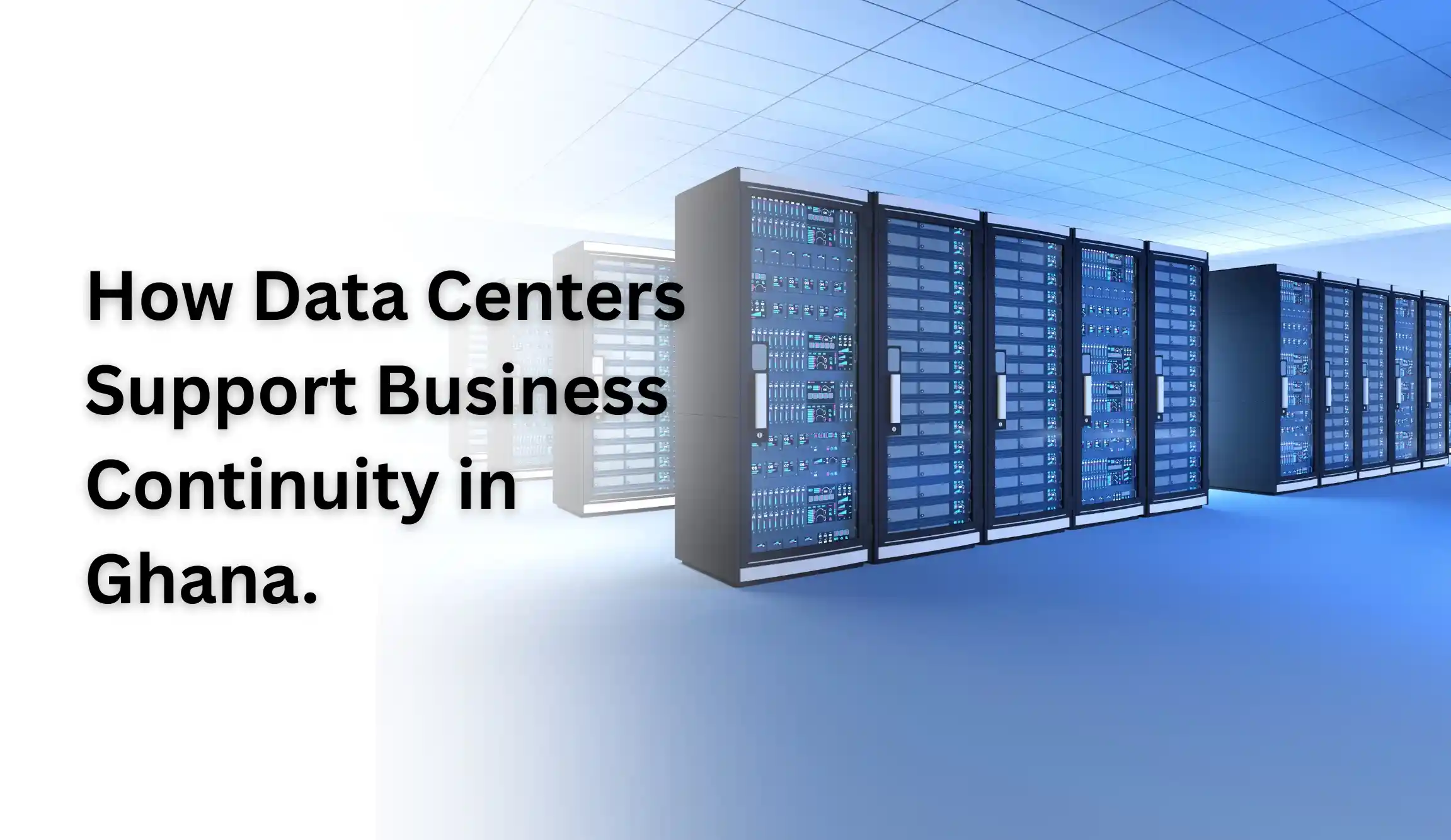
A data center in Ghana guarantees the control, security, and high availability that the on-premises IT infrastructure could hardly maintain. It gets rid of the single points of failure by providing redundant power systems (including uninterruptible power supplies and generators), advanced cooling technologies, and several high-bandwidth internet connections.
This is even more so in Ghana, where businesses have to cope with local infrastructure problems and, at the same time, meet the standards for both national and international compliance.
Ghanaian businesses can already put their focus on innovative ideas, customer service, and core business growth rather than managing hardware and uptime by putting their core IT infrastructure in a tier-rated data center. Predictable operational expense, a partner in risk mitigation for the company, and seamless scaling without the capital expenditure of building their own facility are all possible through the data center. Check our top data center solutions for Ghanaian businesses.
Key Data Center Services That Power Uninterrupted Operations
Leading data centers in Ghana provide a variety of integrated services to fully support business continuity. These services are not separate, but rather, they are components of a comprehensive continuity strategy that are interconnected. Learn how to optimize your office network for better performance alongside these services.
Enterprise-Grade Hosting, Robust Backup, and Disaster Recovery Altogether
- Professional Hosting and Colocation: The main component of a data center is that it provides the physical location for companies' servers, network equipment, and storage systems. Through colocation, businesses can place their own hardware in power, cooling, and physical security that are carrier-neutral and superior to other facilities. Otherwise, they can use the data center's infrastructure for fully managed hosting.
- This guarantees that applications, databases, and websites run on the best, always-on infrastructure, which is the first and most important layer of continuity.
- Automated Cloud Backup Solutions: Routine, dependable backups act as the safety net for every organization. Contemporary cloud backup in Ghana that is hosted in the local data center presents major benefits. It transfers data from the on-site systems that are vulnerable to an attack or natural disaster into a separate, secure vault that is geographically distant.
- Top providers present automated, encrypted backup procedures that incrementally capture changes in data, hence cutting down on the loss of data windows. A local cloud backup solution takes much less time to recover data and has no latency and data sovereignty issues that are sometimes associated with purely offshore cloud storage.
- Disaster Recovery as a Service (DRaaS): Backing up is safeguarding data, while disaster recovery is reviving operations. DRaaS is a high-tech, intricate service that allows an organization to switch over its complete IT environment to the data center's cloud or backup infrastructure during a major incident. This means if a company's main office or server room has been broken into, employees can continue working by logging into the data center and accessing the same systems that are mirrored. Recovery Time Objectives (RTO) and Recovery Point Objectives (RPO) become defined and tested in the contract, turning disaster recovery from a promising plan into a reliable, operational procedure.
Tangible Benefits of Partnering with a Reliable Data Center in Ghana
The selection of a data center partner gives the Ghanaian enterprises direct and measurable benefits, which in turn stimulate their growth and stability. Let's check some of them:
- Enhanced Reliability and Reduced Downtime: The tier III+ data centers in Ghana, with their duplicate systems for every critical part—power, cooling, and network, guarantee more than 99.982% uptime. This resilience, designed by the engineers, means that the business's customers and staff will always be able to access the services.
- Superior Security and Compliance: Data centers create very large security layers that cannot be duplicated in a typical office: constant surveillance, biometric access controls, security guards, and secure cages or cabinets. These measures prevent physical theft, tampering, and unauthorized access. Besides, the use of such facilities gives a reputation for how the business stands with meeting data protection laws because they provide secure environments and certifiable controls.
- Scalability and Cost Efficiency: Data center services have a flexible, pay-as-you-grow model for the entire duration of the company's operations. Businesses can scale compute, storage, and bandwidth up or down without the lead time and capital outlay required for new hardware. This converts large, unpredictable CAPEX into manageable, predictable OPEX, thus the company could invest that money into other areas that are of strategic importance.
- Access to Expertise and High-Performance Connectivity: A partnership with a data center brings businesses indirect access to a team of infrastructure, network, and security experts. Besides, carrier-neutral facilities give direct access to a number of local and international internet service providers and network carriers, thus the performance, resilience, and often the cost of the bandwidth will be the best possible.
- Focus on Core Business Objectives: This might be the most important advantage of all; the internal IT teams are set free. The daily routine of keeping and monitoring physical infrastructure is taken off the shoulders of these resources, which are considered valuable. The IT teams then concentrate on the projects that give the company competitive advantages and innovations, such as creating new applications for customers or perfecting business processes.
In summary, the Ghana Digital Economy is still in its infancy but is very promising, and therefore, more and more companies will be relying on data center infrastructure. Data centers are and will be the key factor in business continuity, allowing companies from all sectors to operate confidently. Through the various core services that data centers provide, such as professional hosting, cloud backup, and disaster recovery, they turn business continuity into a proactive part of daily operations that will enable the Ghanaian companies to be victorious in a world of uncertainty and able to grow without any limitations. Contact us today to learn how we can support your business continuity.
FAQs on Data Center in Ghana
Will a local data center increase performance for my users in Ghana?
The main benefit of a data center in Ghana is reduced latency for the apps and data on it. When your servers are in Accra or Tema, the data has to travel a much shorter distance to your users in Accra, Kumasi, or Takoradi than if it were to be hosted abroad. This difference in distance leads to faster web loading times, software that is more responsive, and upgraded user satisfaction.
Is the backup of cloud data in a Ghanaian data center safe and compliant?
Absolutely. Trusted cloud backup service providers use strong encryption methods similar to those used in banks for data transfer and storage. Backup data stored in a data center that is certified in Ghana also means that it is subject to the regulations of that particular country, thus making it easier to comply with the Data Protection Act, 2012 (Act 843) and other regulatory requirements specific to your sector.
What is the distinction between a backup and a disaster recovery plan that is kept in the data center?
A backup refers to a duplicate of the information on your computer. Disaster Recovery (DR) is a detailed strategy that employs those backups to bring the full business operations back up after a major outage. A data center allows both to happen: it keeps your backups safe and then also provides the redundant infrastructure (servers, networking) for you to "spin up" your whole IT environment quickly as part of a managed DR Service, reducing operational disruption.
Do small and medium-sized enterprises (SMEs) have access to the services from data centers?
Of course. Data centers cater to large companies and small businesses alike. The flexible, pay-as-you-go model makes them perfect for SMEs. A small company can first use a simple cloud backup service or run a vital application on one virtual server, then increase staff according to its growth. Thereupon, the smaller companies will enjoy the same resilience that is usually provided for the bigger companies without having to pay the same amount.
What factors should I be considering if I were choosing a data center partner for business continuity in Ghana?
The main factors are: Tier Certification (verifying levels of redundancy), uptime guarantees (SLA of 99.9%+), security provisions (both physical and digital), power redundancy (UPS, generators, fuel contracts), carrier neutrality, skilled technical support, and a well-documented disaster recovery service that is clear to clients. Also, it is very helpful to have proven local experience and client referrals.