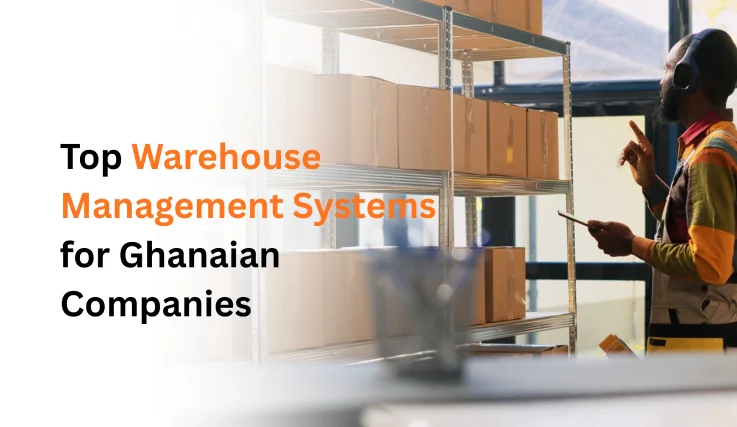
Top Warehouse Management Systems for Ghanaian Companies
The mastery of inventory and logistics is a very crucial competitive edge for companies in Accra, Kumasi, and Takoradi that are active in Ghana's invigorating commercial environment. These firms are realizing the importance of using advanced digital tools to simplify complicated supply chains and, at the same time meet the escalating demands of customers. A Warehouse Management System (WMS) that is tailor-made for a particular need, such as this one, holds the key to the transformation of the operation of a warehouse that was once a possible obstacle to being a steady springboard for growth. Through this detailed analysis, we would be able to reveal the major suppliers of warehouse management solutions in Ghana, exploring their significance, visiting the top platforms, and portraying the essential functions that generate actual profits that are detectable to those savvy enterprises, thereby providing the catalyst for the investment.
Why Warehouse Management Systems Matter
In today's modern supply chain, the warehouse is the center of all operations where the trade of goods is managed. If it is missing, the companies have to face a number of obstacles: the goods are not in the right amount, then the deliveries are late, and customer complaints increase, to name a few. In the continuously growing market of Ghana, the consumer internet, and regional digital commerce, gaps like these could substantially hold back the scaling and profit creation of a player.
Executing a warehouse management system denotes an overhead-free digital center of the wisdom of all movements in logistics. The system removes the manual paper and spreadsheet logging and provides the company with automated and real-time data gathering. For those companies that are stretching their horizons, the change is non-negotiable as it brings the benefits of being able to see all movements, managing them closely, and having the intelligence platform for decision-making at the logistics end.
Logistics: Its Efficiency and Accuracy
A top WMS system does a lot more than just the two main operational issues: efficiency and accuracy. In the first case, you will get the help that comes from smart process automation. It means that the system is able to define the most efficient routes for order picking, guide put-away locations in terms of item turnover, and sequence tasks for warehouse employees in the best order. The outcome of all these precautions results in much quicker order processing, enlargement of daily throughput, and efficient use of all the given facilities, both labor and storage.
Accuracy is a complementary but equally important partner. The wrong stock monitoring leads to the unavailability of stock in the market, having too much stock, and sending out wrong deliveries that may harm the brand. A good warehouse management system helps with accuracy since it uses barcoding and RFID to track inventory. The precise location of the inventory is done through the scan, and so every movement of an item from receiving to staging, shipping, is immediately recorded. This then becomes a more secure place of reference for stock levels. For Ghanaian businesses, this means no more of the troubles of stocktaking, unmatched ledger records, and thus leading to the perfect service provision for customers, an increase in their loyalty, and the shrinkage and obsolescence losses dropping significantly is one of the many benefits of the same.
Best Warehouse Management Systems
Choosing the right WMS requires comparing the software's strengths with the organization's specific scale, industry, complexity, and growth objectives. The international market provides options ranging from full-featured global platforms to adaptable, modular systems. In the Ghanaian case, the principal figures in the selection were the availability of reliable local support, flexibility with the local infrastructure, and the general user-friendly aspects. For enterprises in Ghana, these are the systems that have shown very good efficiency. See our guide on How to Choose the Right Inventory Management Tool and best inventory software in Ghana.
IPMC, Odoo, and SAP
IPMC's Warehouse Management Solutions:
Being a West African technology integrator of high standing, IPMC is a provider of WMS options that are customized for the business environments of Ghana. The elements that set their solutions apart include profound insight into the regulatory, infrastructural, and market peculiarities of Ghana and the larger ECOWAS region. With a strong focus on core warehousing functionality, IPMC's inventory software has the edge of its support and training teams being right there beside the customers. The collaboration with the local partner could be extremely beneficial for those companies that give top priority to having direct and quick help for the implementation and continuous system development, making the operations fit the local ways of working.
Odoo Inventory & Warehouse:
Odoo has a reputation for becoming a widely used suite of integrated business applications accessible as open source. The Warehouse Management module of the software is said to be a very good choice, and so mainly for small to medium-sized companies (SMEs). The key advantages of the software are the separate modules and the cost efficiency. Companies are able to start with basic tracking of inventory and management, then they can gradually add the modules for Sales, Purchase, Manufacturing, Accounting and as per the growth of the company. The software is user-friendly, and with a wide range of customization options, Odoo provides Ghanaian businesses a pathway where their logistics software can be accommodated as fast as their business scales without needing a huge initial investment.
SAP Extended Warehouse Management (EWM):
SAP EWM is the industry's top enterprise-grade solution that caters to international small to medium-sized companies, large corporations, or firms located in Ghana with very complicated and high volumes of logistics requirements. It constitutes one of the SAP S/4HANA suite modules and is designed to run highly complex, even fully automated, warehouse operations along with complicated supply chain networks. SAP EWM is able to cover advanced functionalities such as detailed labor management, yard logistics, cross-docking, and integration with AS/RS, a technology for automatic storage and retrieval. Although presenting a larger financial commitment and more detailed roll-out, it also brings a completely new level of functionality, analytics, and global supply chain integration for the benefit of companies that are operating at an international and large scale. Companies using Tally ERP may also consider integration options.
Key Features of Effective WMS
Besides looking into the individual suppliers, the most effective way to get the right Warehouse Management System that you can count on is through the features that form the core part of its successful operation. Companies in Ghana need to take on the features that are the main business categories that meet the operational challenges they are facing. These features include:
- Real-Time Inventory Visibility: The very first feature is the real-time inventory visibility. The WMS that is efficient will enable its customers to view on a spot, and meanwhile, the correct location, number, and quality of all goods that are moving through all warehouse storage areas, with their respective statuses, will be available. This immediate visibility is not only a tool for data-driven decision making but also an answer to customer calls complaining about the lack of an impending product shipment.
- Integrated Barcode/RFID Scanning: To reach the required accuracy for the needed advanced operations, the agile scanning hardware support is a must. The system should allow the scanning of the items, containers, and orders at every stage of the warehouse process by human or machine, and, therefore, remove any human-related data-entry mistakes.
- Smart Location & Slotting Management: An optimal warehouse management system should automatically identify and allocate the best location for the new incoming products based on some of the pre-configurable rules, e.g., the size, the velocity of turnover, or the affinity of the product. This clever slotting practice results in far better space occupancy and cuts down on the picking time.
- Picking and Packing Workflows That Are at a Higher Level: It is a must for the user to have several picking methods to choose from in the software. This can range from batch, using the wave, to the zone picking method that suits the accurate order profile. The process coming from the system should be the pick list being optimized and the routes being printed, along with the packing stations being guided by the system for the verification steps, and the shipment being accurate with the steps.
- Receiving and Put-Away Made Simple: A boost in the productivity of the inbound operations is imperative. A warehouse management system with advanced shipment notice and receipt verification systems integrated into it may be referred to as a powerful helper in the whole process. This is due to the fact that the system's operation is followed by creating a put-away task immediately and a quicker placement of the goods on the shelves for the customers' perusal.
- Analytics and Reports that cover it everything: Robust analytics fuel data-driven decision-making. Dashboards and detailed reports on KPIs are offered by a typical modern WMS, which encompasses order cycle times, picking accuracy rates, inventory turnover ratios, and storage density. Knowledge in this area is indispensable for incremental operational efficiency.
- Seamless Ecosystem Integration: It is required that a WMS has an easy connection with other company systems. Some of the system integrations that are a must-have are Enterprise Resource Planning (ERP) software, e-commerce platforms, accounting systems, and transportation management systems (TMS). This method of operation ensures the flow of information from customer order to final delivery in an integrated manner.
- Scalability and Cloud Architecture: The system that your company chooses must be able to expand with you. The use of cloud-based Software-as-a-Service (SaaS) WMS models is becoming more and more popular as time goes by, and they come with different kinds of benefits, such as lower upfront capital expenditure, automatic updates, and secure remote access, which is especially significant for managers who need to be able to supervise operations from anywhere.
A business in Ghana that installs a Warehouse Management System of high quality makes the achievement of operational excellence a part of the business. The installation of a Warehouse Management System signifies a strategic operational commitment to the operational excellence of Ghanaian companies. The management of a company requiring efficiency and accuracy in logistics may be carefully done by weighing such factors as the most effective solutions being IPMC, Odoo, and SAP, and the on-time delivery of features that ensure real-time control and intelligence. Companies may turn their warehouses into powerful assets. The right inventory software and stock tracking features provide the transparency and command that are critical to do well in today's interconnected market, thus laying down a foundation for sustainable growth and customer-centric victory.
For more information or personalized consultation, contact us.